
Education
Why certification matters
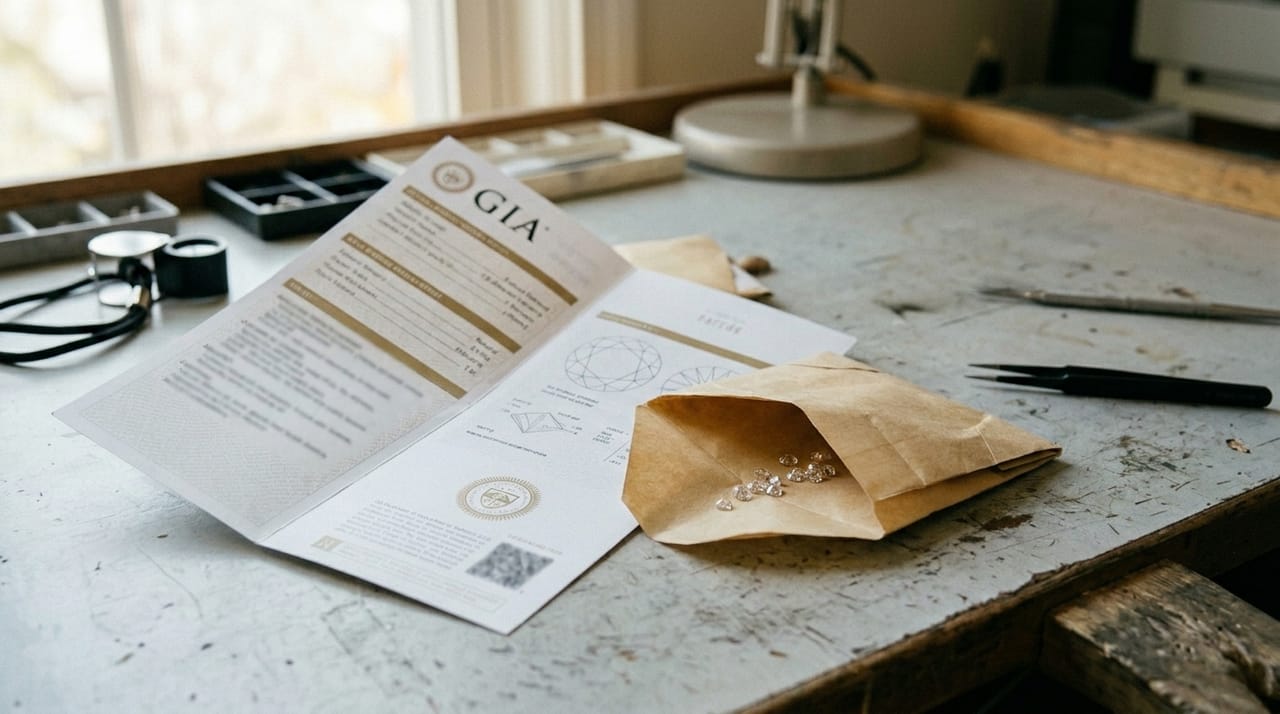
Every diamond we hold is independently graded by the Gemological Institute of America (GIA) — not by us, and not by the supplier we bought the stone from. That distinction is the entire reason certification exists.
What a GIA report actually says
A GIA report records what an independent laboratory observed about a specific stone: its measurements, weight, the four characteristics (cut, colour, clarity, carat), and any treatments. The report is keyed to a unique number — the same number we list on every diamond card on the site. If a stone is laser-inscribed (most are), that number is etched onto the girdle, microscopically, so the report can always be matched back to the physical stone.
What it doesn’t say
A GIA report doesn’t set a price and doesn’t make a recommendation. It’s a factual record, not an appraisal. Two stones with identical grading reports can sell for materially different prices depending on how each grade was reached — a "VS1" stone with a centrally-placed inclusion shows differently from one with the same grade but a peripheral inclusion, and the report doesn’t always make that distinction obvious in text.
This is one of the reasons we insist on seeing every stone in person before we recommend it. The report sets the floor; the eye sets the ceiling.
Why we use GIA and not the alternatives
There are several reputable grading laboratories — IGI, HRD, AGS — and each has a defensible methodology. We use GIA because:
- Its grading scale is the most conservative across the industry. A GIA G is, in practice, half a grade brighter than the same letter from a less strict lab.
- Its colour and clarity grades carry the least drift across reviewers. A second opinion on a GIA stone almost always lands at the same letter and number; the same can’t consistently be said elsewhere.
- It’s the standard your insurer, your future jeweller, and any second-hand market will expect to see.
If you’re ever shown a stone with an in-house "grading certificate" only, or with a report from a laboratory you don’t recognise, ask for the independent paperwork. There’s no good answer for not having it.
Where to see the reports
Every diamond modal on the inventory page lists the GIA report number for the stone. You can look it up at gia.edu before any conversation with us — and we’d encourage that. The whole point of independent grading is that you don’t need to take our word for it.