
Education
The 4Cs, briefly
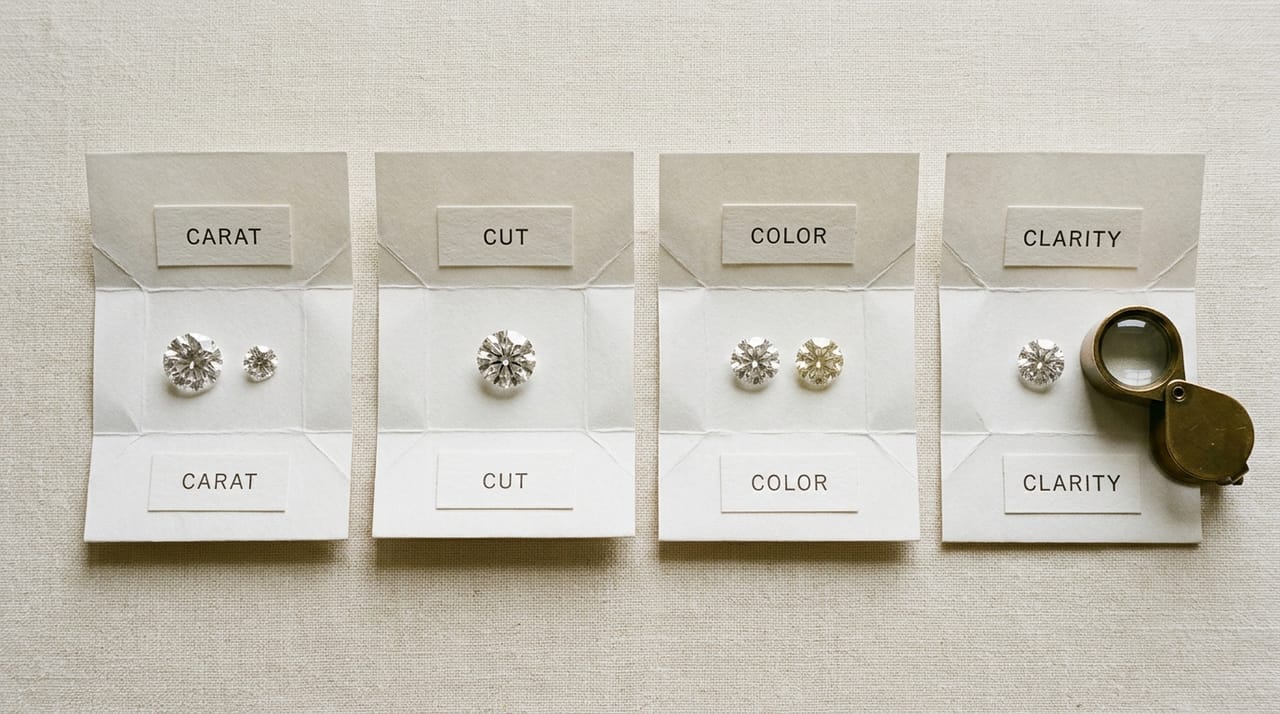
Every diamond is graded against four characteristics, set out by the GIA in the 1950s and adopted as the global vocabulary of the trade since. Knowing them well enough to ask the right questions is most of what a first-time buyer needs.
Cut
Cut is the only one of the four that comes entirely from human hands. A diamond’s rough crystal sets its potential; the cutter’s decisions decide how much of that potential reaches your eye. GIA grades cut on five levels — Excellent, Very Good, Good, Fair, Poor — and applies the grade only to round brilliants. Other shapes (oval, cushion, emerald, pear) aren’t graded for cut because there’s no single ideal proportion agreed for them.
If you only optimise one of the four, optimise this one. A well-cut stone in a slightly lower colour will out-sparkle a higher-colour stone with a mediocre cut, every time.
Colour
Colour is graded D to Z, with D, E, F described as colourless, G–J near-colourless, and the lower letters carrying increasingly visible yellow or brown body colour. In a white-metal setting, most people stop being able to tell the difference somewhere around H or I — the perceptual gap between D and F is real on paper and almost invisible in the ring.
Clarity
Clarity describes the inclusions inside the stone and the blemishes on its surface. FL and IF are flawless or internally flawless. VVS1 and VVS2 require ten times magnification and a trained eye to spot inclusions. VS1, VS2 are eye-clean for almost all stones. SI1 is usually eye-clean depending on where the inclusions sit. Below that, inclusions become visible without magnification.
For a setting that will be worn daily, anything VS2 or better is indistinguishable to the wearer. Paying for FL is paying for the report, not for the ring.
Carat
Carat is the easy one — it’s weight, not size. One carat is 0.20 grams. Price doesn’t scale linearly: a 1.00 ct stone is typically far more expensive than a 0.90 ct stone of identical grade, because the round numbers (1, 1.5, 2) carry a premium. If size matters more than the certificate, shopping the 0.90s and 1.40s is a quiet trick worth knowing.
How we weigh them in practice
When a buyer asks us to prioritise, we usually answer the same way: cut first, then carat, then colour, then clarity — because cut decides whether the stone sparkles, carat decides what it looks like across the room, and the last two matter mostly on paper. Your priorities may differ; this is the order we’d hand a friend.
If you want to see the framework applied to specific stones, browse the current inventory — every card carries the four grades, and the modal shows the GIA report number for cross-reference.