
Portfolio
A solitaire, quietly considered
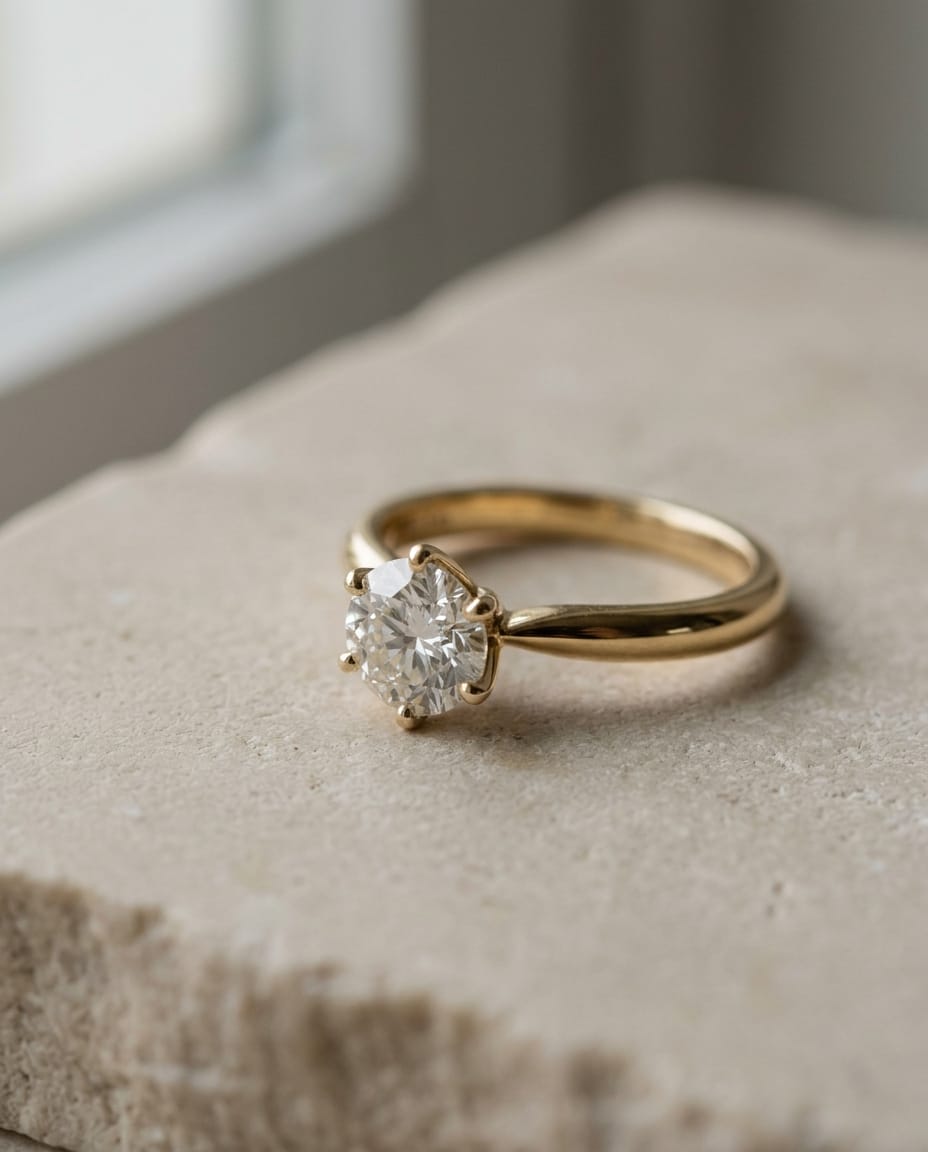
The brief, when it arrived, was unusually exact: "A round-brilliant solitaire. No halo, no side stones, no twist. Yellow gold. Thin band. Make it disappear when she’s not looking at it."
We didn’t start with a stone. We started with the band — five months of back-and-forth on the ring she wears every day, the way a 1.6mm shank would catch on a sleeve, the way 1.8mm wouldn’t. By the time we picked the diamond, the setting was already designed around her hand.
The diamond
A 1.20 ct round brilliant, F colour, VS1 clarity, cut to GIA Excellent across the three categories. We sourced three candidate stones from the safe and met for an afternoon to look at them under window light, daylight bulbs, and the workshop’s magnifier. The chosen stone was the second-largest of the three, by a small margin — picked because its cut was visibly sharper across the table and the inclusion was tucked under a prong before we’d even finalised the design.
The setting
Four claws, knife-edged, in 18k yellow gold. The shank tapers from 1.8mm at the shoulders to 1.6mm at the base — almost imperceptible, but it sits flatter against the finger and lets the stone read larger from above. The basket is unusually low, which puts more of the diamond above the metal and lets the daylight hit the pavilion as cleanly as the table.
What we learned
The instinct on a brief this restrained is to over-engineer the "signature" — a hidden detail under the basket, a maker’s mark inside the shank, something for the wearer to find. We didn’t. The point of the brief was to take everything away that didn’t need to be there. The mark is the absence.
If you’re thinking through a similar piece — or one quite different — the contact page is the right starting point.